Over ninety percent of potential drugs fail in biotech and pharma pipelines somewhere between early discovery and Phase III. Ask a group of chief medical officers why and you’ll hear a familiar line: “We don’t fully understand biology.” Watching change programs over the last thirty years with a similar success rate, it’s tempting to say, “We just don’t understand psychology.” However, if we don’t sharpen our ability to understand humans quickly, we’ll miss this once-in-a-generation opportunity.
Understanding humans is tricky. We have to deal with thin and noisy data, constant change, biased methods and interpretations, and a lot of cognitive and emotional stuff just beneath the surface. Most instruments we employ aren’t very helpful. Likert scales and colored boxes strip away context, and the pressure to score well distorts reality. Chasing external benchmarks often pulls attention outside the walls and away from the issues that matter most.
And the issues that we’re overlooking are often right under our noses. A McKinsey report on strategic failure cited four main causes: Not understanding the problem, the organizations abilities, the immovable pressures, or the cultural landscape. This lack of understanding leads to billions in lost capital from failed acquisitions, reinventions or reorganizations. Not recognizing the realities in which we operate indeed has dire consequences.
Meanwhile, the fuse is burning. Strategy cycles are compressing, AI has moved from the edges to the center, and leaders are placing big bets while employees try to move from anxiety to action. Superficial surveys won’t get us there. Better decisions will, but only with more clarity and insight.
So, the question isn’t “How do we listen more?”, it’s “How do we listen to what matters?”
Now imagine you have your own AI that spends their time in confidential conversations with your employees and customers to learn what really matters to the people who matter most. Your AI asks real questions, mirrors back to check understanding, follows up, and goes deeper when it gets interesting. Then it organizes what it heard by role, region, or theme. It notices tonal shifts, contradictions, workarounds, and bright spots. It points to where value is hiding, where risk is compounding, and which small changes are likely to unlock the greatest impact. It doesn’t give you another dashboard to stare at. Instead, it co-creates an evidence-based change roadmap that you can kick-off next week.
This evolution isn’t about replacing humans or fully outsourcing our empathy. It’s about using AI for its bionic capabilities; asking, digging, tagging, clustering and sense-making. Then our leaders can focus on judgment, trade-offs, and having the courage to decide and move. The ideal blend is AI-forward and human-driven. Our systems should synthesize the forest and allow our leaders and advisors to walk the trees, pressure-test findings, and make the calls on the best path forward.
Tools like this are starting to see the light of day. Our AI, Vega, is trained as a behavioral scientist to reveal those deeper realities. From study design to analysis, instruments like Vega open executives, managers, and practitioners to a new paradigm of research. We’ve launched studies in 24 hours and analyzed hundreds of qualitative inputs in days. With less time and more pressure, this path of precision research creates new standards for both accuracy and speed.
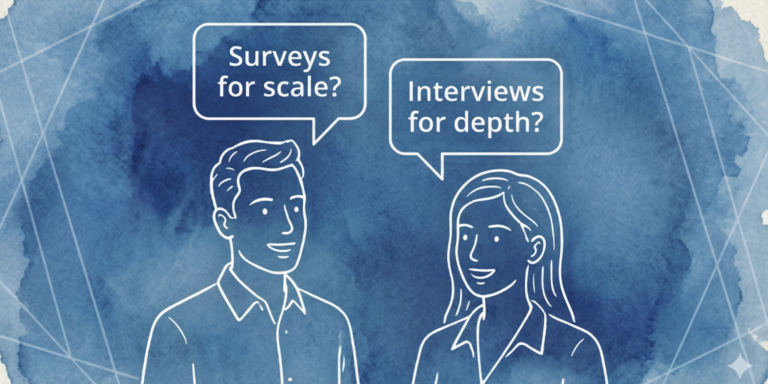
Leaders heading into 2026 are making critical choices: where to invest, which behaviors to model, and which use cases to scale. There is no universal roadmap. Context and tone matter more than ever. So, imagine having your own AI that can listen, organize, and prioritize, then deliver you the moves that make the difference. The future won’t be created by another quarterly bundle of quantitative data points. It will reward teams that hear clearly and act decisively. As you shape your listening strategy for the year ahead, ask: Is this the best way to listen—so we can make the decisions that matter?