Let’s start with a sobering set of facts. 92% of the Fortune 500 is actively adopting generative AI and 1% describe their rollout as ‘mature.’
Let that one simmer while you absorb this next one: 93% of leaders say that their AI pilots met or exceeded expectations, yet only 5.5% have seen a meaningful ROI.
The demand is significant, the mandates are in place, and the results continue to be so far below the bar that nobody wants to talk about why.
My firm has been studying this paradox for over a year now and the published cases are validated in our own research. This isn’t a problem of infrastructure, licensing agreements, or strategic partnerships with LLMs.
This, my friends, is a human problem.
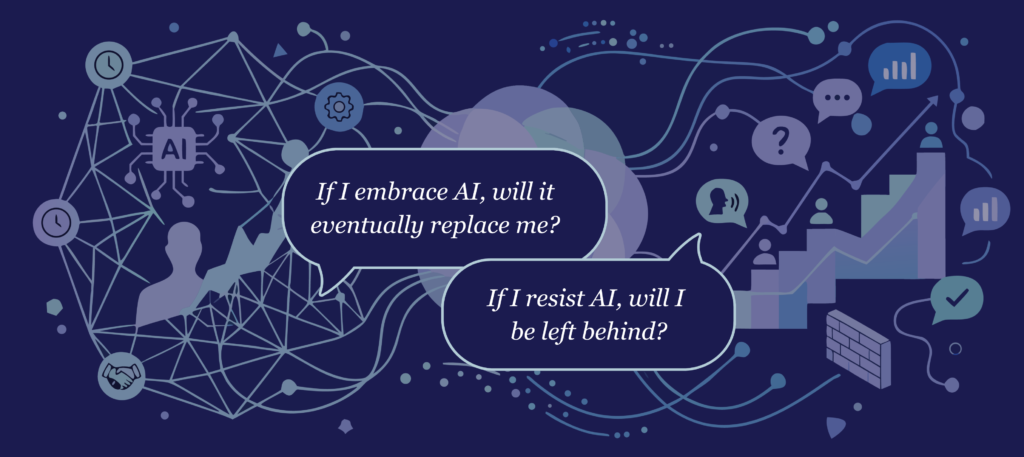
Even with the best tools and technology roadmaps, from top leadership to the shop floor, employees at all levels are faced with two primal fears hitting them at once — being replaced or being left behind.
The Shadow Economy
In environments rich in fear and uncertainty, you’ll almost always find people hiding.
- A study by Henley Business School found that 26% of employees using AI are actively hiding it from colleagues and managers.
- A WalkMe survey reinforced this pattern: 45% of their workers have pretended to know how to use an AI tool in a meeting to avoid scrutiny from their peers or bosses.
- A study by KPMG found that 57% of employees admit to submitting AI-generated deliverables without disclosing it.
How are executives supposed to drive adoption when AI efforts and motivations are living in the dark?
This shadow economy should be alarming for all of us.
As my colleagues and I attend the conferences and have these discussions, the human issues are rarely on the agenda. It’s like we know that people are the primary issue, but as we make promises to our boards, the need for control and looking good takes over. Then we continue to talk about our licenses and experiments and pretend we’re all excited about the progress that isn’t really happening.
Leaders Are the Lever
A recent McKinsey study revealed something telling about the state of leadership.
- C-suite leaders estimated that 4% of their employees are using generative AI for about 30% of their work.
- Employees’ self-reported 13% usage is more than three times what leaders acknowledged.
This reinforced what we’ve seen in our own research time and time again. Leaders are systematically blind to what’s happening in their businesses.
Not being on the pulse could be a result of incomplete data, or the rose-colored glasses that get us through the day. But the bigger issue is modeling. Over 30% of the employees in our study cite the absence of leadership modeling as the key barrier to broader AI adoption.
If leadership isn’t holding their end of the bargain, employees remain on the sidelines.
These issues aren’t evenly distributed. Engineering teams average almost 30 hours a week of AI use while HR and Sales average around five.
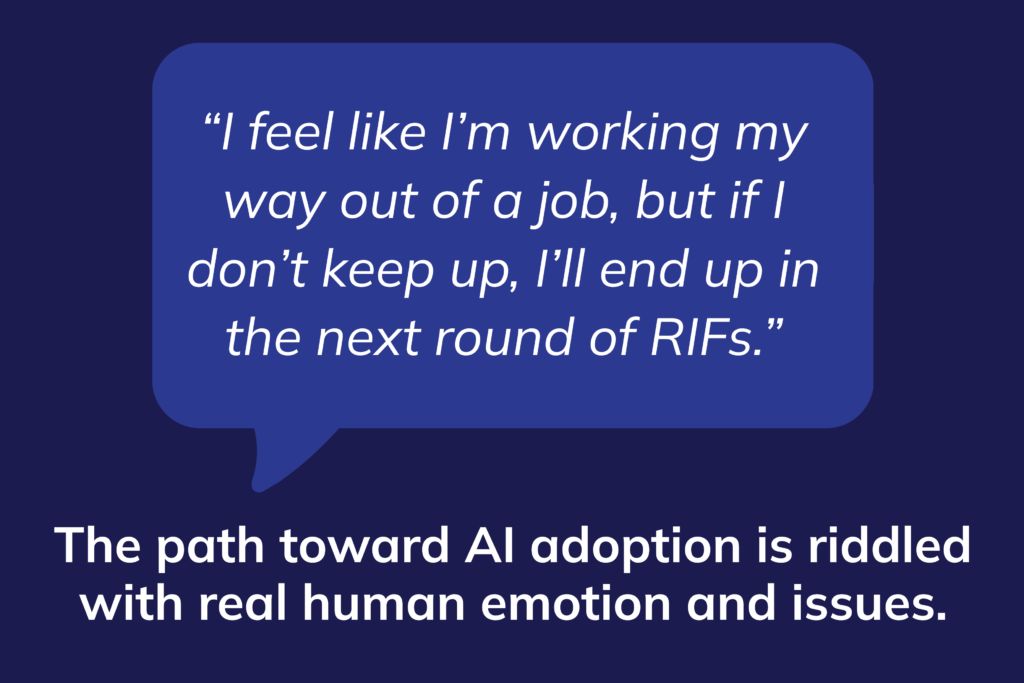
The engineers in our studies are candid about their fears, “I feel like I’m working my way out of a job, but if I don’t keep up, I’ll end up in the next round of RIFs.” While engineers are building at speed, people leaders are cautious and discerning. Looking up from the desk of an individual contributor, the dissonance is hard to miss.
Creating the Conditions for Adoption
Let’s quickly move past the obvious. Leaders, you’re both the problem and the solution.
Experimentation mandates haven’t worked and it’s time to mature your proposition. Employees need to see your
AI-enabled improvements in your leadership and productivity. If AI is making you better, they’re compelled to play along.
When you aren’t on the pulse of the issues, they have every reason to disengage. Knowing the pain, feeling the fear, expressing your own insecurities, now we’re getting somewhere.
The path toward adoption is riddled with real human emotion and issues.
“Can I really do this?” “Will I still have a job?” “How will this transformation affect my ability to take care of my family?” These are questions with big consequences, and they’re the primary hurdles standing between your AI strategy and business transformation.
If you truly want your people to join you on this mission, you may want to spend less time evaluating toolsets, and more time looking into the eyes and concerns of the people being asked to change.
Let’s start by recognizing that we’re in this together, experiencing the most profound set of changes in our lifetimes.
As leaders, managers and individual contributors, let’s talk about these implications and the complex set of issues and emotions that emerge. Let’s create places of safety and be honest with ourselves and our peers about what will help us achieve our collective ambitions with empathy and humanity.
If you want to better understand your company’s level of AI Readiness, reach out to us at Agency 150 to learn about Vega and our AI diagnostics.